You are here: resources › Downloads › ViewStruct : A Tool for Visualizing Crystal … › About
ViewStruct : A Tool for Visualizing Crystal Structures - Documentation and Downloads
Category
Published on
Abstract
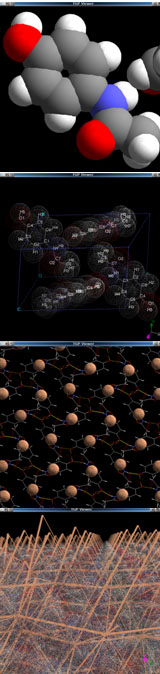
ViewStruct is a program that visualizes crystal structures and that can calculate and visualize the corresponding crystal graph. A browser-based version is also available on pharmaHUB.
The crystal graph is a formalization that stems from the Hartman–Perdok (HP) theory [3, 4, 5]. HP theory addresses crystal growth and is particularly useful to predict crystal morphology. In HP theory those elements that take part in the process of crystal growth are called growth units. Growth units are typically ions when salt crystals are formed and they are typically single molecules when molecular crystals are concerned. In essence the crystal graph describes the energies of interactions between these growth units. When drawn in the unit cell, the directionality of the interactions becomes apparent. Also, the cooperative effect of the different interactions in their 3-dimensional arrangement becomes visible when a crystal graph is drawn. The crystal graph can be used to assess the (an)isotropy of the crystal structure, slip planes, and ultimately the morphology and growth mechanisms [1, 2].
License information
VIEWSTRUCT is released as free software according to the GNU GPL 2.0 license. A copy of that license should be included with the program package and can also be found at http://www.gnu.org.
VIEWSTRUCT is based in part on the work of the FLTK project (http://www.fltk.org).
For support on Microsoft Windows, VIEWSTRUCT uses the cygwin dll library. http://www.cygwin.com/licensing.html
VIEWSTRUCT can be compiled either using Glut-3.7 or freeGlut-2.4.0
References
[2] SXM Boerrigter, GPH Josten, J van de Streek, FFA Hollander, JLHM Cuppen, P Bennema, and H Meekes. Monty: Monte carlo crystal growth on any crystal structure in any crystallographic orientation; application to fats. J. Phys. Chem. A, 108(27):5894–5902, JUL 8 2004.
[3] Piet Hartman and W. G. Perdok. On the relations between structure and morphology of crystals. i. Acta Crystallogr., 8:49–52, 1955.
[4] Piet Hartman and W. G. Perdok. On the relations between structure and morphology of crystals. ii. Acta Crystallogr., 8:521–524, 1955.
[5] Piet Hartman and W. G. Perdok. On the relations between structure and morphology of crystals. iii. Acta Crystallogr., 8:525–529, 1955.
[6] S. L. Mayo, B. D. Olafson, and W. A. Goddard III. Dreiding: A generic force field. J. Phys. Chem., 94:8897–8909, 1990.
Cite this work
Researchers should cite this work as follows: